
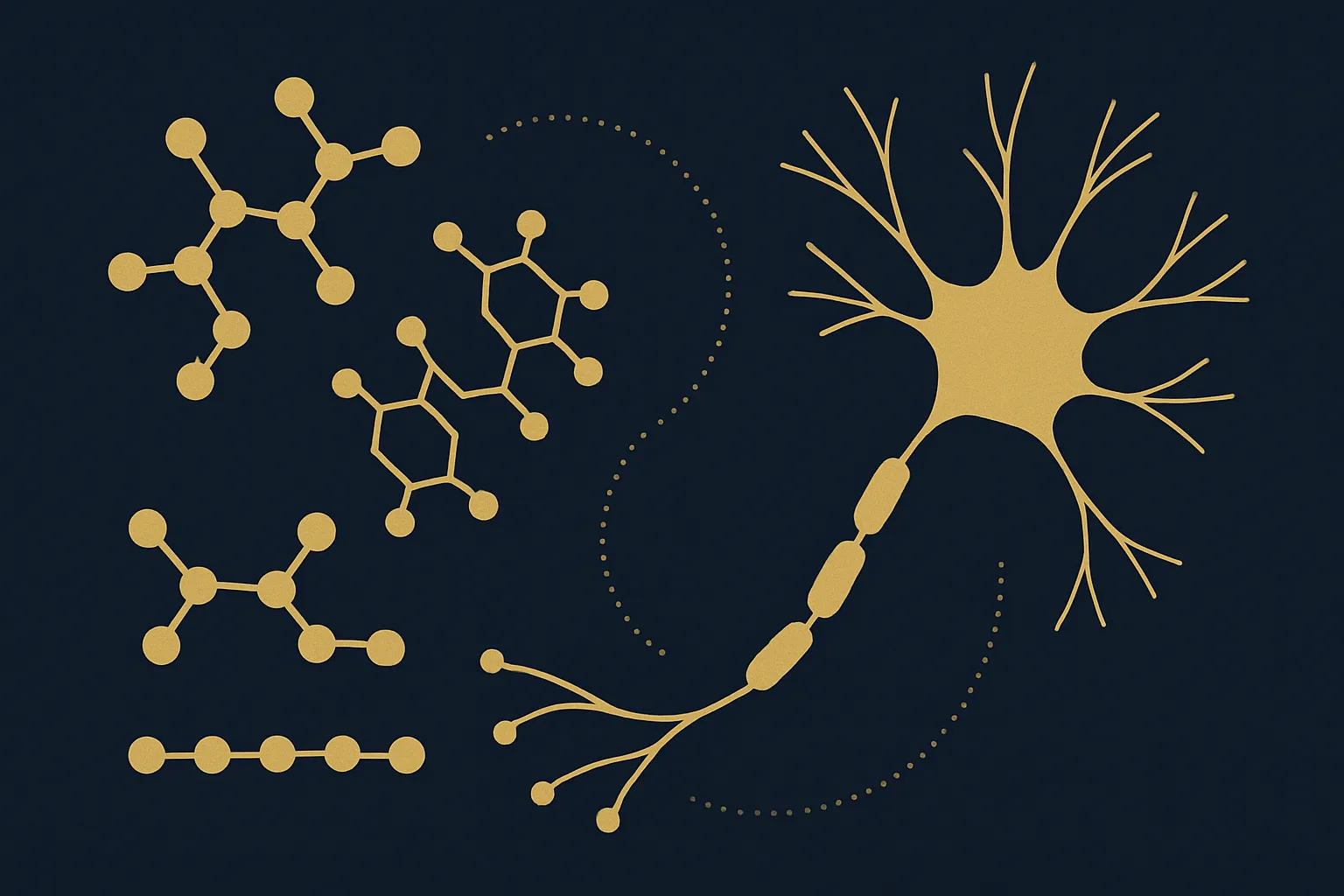
Neuropeptides constitute a chemically and functionally heterogeneous class of signaling molecules that supplement and modulate classical neurotransmitter systems at synaptic and extrasynaptic sites. Distinct from small-molecule neurotransmitters (GABA, glutamate, dopamine) released from small synaptic vesicles in the 100–200 Å diameter range, neuropeptides are synthesized as large precursor proteins in the endoplasmic reticulum, processed by prohormone convertases (PC1/PC3, PC2) in the Golgi and dense-core vesicles, and released in a calcium-dependent but typically high-stimulation-threshold manner. This article examines neuropeptide synthesis, release, receptor specificity, and the research-relevant distinctions from classical neurotransmitter pharmacology.
Synthesis and Processing: From Gene to Bioactive Peptide
Neuropeptide biosynthesis begins with translation of prepropeptide precursors (50–300+ amino acids) bearing N-terminal signal sequences directing them to the secretory pathway. In the ER, signal cleavage and disulfide bond formation produce the propeptide. Transport through the Golgi to dense-core vesicles (DCV, 150–400 nm diameter) is accompanied by progressive processing: PC1/3 cleaves after paired basic residues (Lys-Arg, Arg-Arg motifs), carboxypeptidase E (CPE) removes C-terminal basic residues, and amidation (PAM—peptidylglycine alpha-amidating monooxygenase) or acetylation may further modify the C-terminal residue—modifications often critical for receptor binding and proteolytic stability. POMC (pro-opiomelanocortin, 241 aa) produces ACTH(1-39), β-endorphin, α-MSH, β-MSH, and γ-MSH through region-specific PC1 and PC2 cleavage patterns that differ between anterior pituitary (PC1-dominant, ACTH production) and arcuate nucleus (PC1+PC2, α-MSH + β-endorphin)—a paradigm example of cell-type-specific neuropeptide diversity from a single gene.
Release Mechanisms: Volume Transmission and High-Frequency Requirements
Unlike classical neurotransmitters (released by single action potential-triggered exocytosis at active zones), neuropeptides require high-frequency stimulation (typically ≥10 Hz bursts) to mobilize DCVs to release sites. This results in neuropeptide release at perisynaptic and extrasynaptic zones (volume transmission), allowing diffusion to receptors hundreds of micrometers from release sites. The consequence is a temporally and spatially broader signal, acting as a "slow wave" that can modulate the gain of classical fast synaptic transmission across large cortical and subcortical networks. Neuropeptide Y release from ARC neurons, for example, diffuses from presynaptic terminals to Y1R-expressing postsynaptic cells in adjacent layers, modulating GABA release probability up to 200 µm from the NPY source—a scale impossible for glutamate or GABA operating via classical 20-nm synaptic clefts.
Receptor Specificity: GPCRs and Signal Diversity
Neuropeptide receptors are predominantly GPCRs—with Gs (cAMP elevation: GLP-1R, CRF1R, VPAC1/2), Gi/o (cAMP reduction, K+ channel activation: µ/δ/κ opioid receptors, Y1R/Y2R/Y5R, somatostatin SST1-5), and Gq (PLCβ → IP3/DAG → PKC activation: GnRHR, NKR1/2/3, vasopressin V1A/V1B) coupling types. Unlike ionotropic receptor families where one ligand type activates one channel type, the neuropeptide receptor families show extraordinary pharmacological promiscuity: CRF (corticotropin-releasing factor) activates both CRF1R and CRF2R with substantially different downstream profiles; multiple endogenous NPY family members (NPY, PYY, PP) activate overlapping but distinct receptor subsets; and POMC-derived fragments have completely different receptor pharmacology (α-MSH at MC1R/MC3R/MC4R; β-endorphin at μ/δ-opioid receptors). This pharmacological complexity requires peptide researchers to specify receptor subtype engagement, not just ligand identity.
Research Differentiation from Classical Neurotransmitters
- Synthesis location: neuropeptides synthesized at soma and transported to terminals (hours-scale resupply); classical neurotransmitters synthesized locally at terminals (seconds-scale resupply)
- Release threshold: neuropeptides require high-frequency or burst firing; classical neurotransmitters release with single spikes
- Diffusion radius: neuropeptides act at 100s of µm via volume transmission; classical neurotransmitters act at <1 µm synaptic cleft
- Receptor type: neuropeptides predominantly GPCR; classical neurotransmitters have both ionotropic (fast) and GPCR (slow) receptors
- Purity standard for research: HPLC >99%, lot-traceable CoA; peptide identity confirmed by mass spectrometry
All neuropeptide research compounds described are for laboratory and research use only. They are not approved for therapeutic, diagnostic, or clinical applications in humans.